
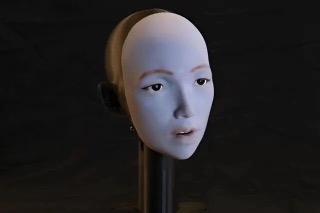
A research team at Columbia University recently unveiled EMO, a novel humanoid robot head that not only achieves "perfect lip-sync" with highly synchronized mouth movements and speech, but can also gradually master human-like vocalization through self-learning—seen as a significant step toward hyper-realistic humanoid robots reminiscent of Westworld.
The robot was developed by robotics Ph.D. student Yuhang Hu, Professor Hod Lipson, and their team. At its core, it's a robotic head structure covered in flexible silicone "skin." Beneath the silicone face, 26 miniature motors are arranged, which when activated in different combinations can pull the facial surface to create various expressions while shaping different lip configurations.
Notably, Yuhang Hu is the founder of AheadForm, an embodied intelligence company established in 2024. Unlike most humanoid robot companies that target "functional tools," AheadForm focuses on breakthrough technologies related to robot "faces," making human-machine interaction more natural.
According to public information, AheadForm received angel round investment from AgiBot at its founding, and has completed 4 consecutive funding rounds over the past year, with its A+ round exceeding RMB 100 million (approximately $14 million).
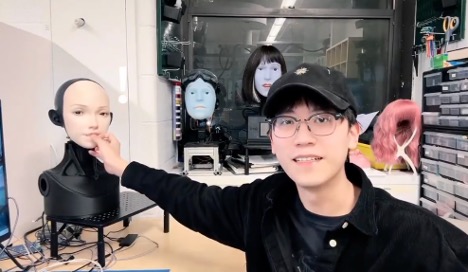
In December 2025, the company launched China's first 1:1 bionic robot based on a game character, "Fang Chengyi," featuring 36.5°C constant-temperature skin and multimodal interaction capabilities, applied in scenarios such as exhibitions and companionship.
To teach EMO how to control mouth shapes using "facial expression muscles," researchers first placed it in front of a mirror, allowing it to randomly generate thousands of facial expressions without human intervention while observing real-time feedback in the mirror. Through this process, the system gradually established correspondences between motor combinations and visual expression changes—this learning framework is called the "Vision-to-Action" (VLA) language model.
After mastering the "expression-motor" mapping, the robot entered the "mimicking human speech" phase. The research team fed EMO massive amounts of YouTube videos of humans talking and singing, analyzing the mouth movement patterns that should accompany different vocalizations, thereby learning lip shape characteristics corresponding to various sounds. Subsequently, the system fused this knowledge with the previously acquired VLA model, enabling the robot to synchronously generate lip movements matching speech content when vocalizing through its synthetic speech module.
Currently, this technology is still not perfect—EMO still faces significant difficulties producing consonants like "B" and "W," and overall lip coordination has room for improvement. Researchers indicate that as the robot continues practicing speech, both its lip control precision and fluency in natural human conversation are expected to improve further.
Yuhang Hu notes that when this lip-sync capability combines with conversational AI systems like ChatGPT and Gemini, human-robot interaction will create a more "emotionally warm" connection. He believes that the more the robot watches human conversations, the more realistically it can mimic subtle facial movements with emotional undertones, and as the "context window" of conversations extends, these expressions and movements will become more contextually appropriate.
The related research paper has been published in Science Robotics, with additional technical details released by Columbia University's School of Engineering. This work is viewed as a key advancement in driving future natural interaction capabilities for social robots, virtual hosts, and humanoid service robots.
Key Technological Breakthroughs
Previous Article
About the Author
Robotics Insider
Industry analyst with 15+ years of experience covering robotics and automation technologies.
View all articles


