
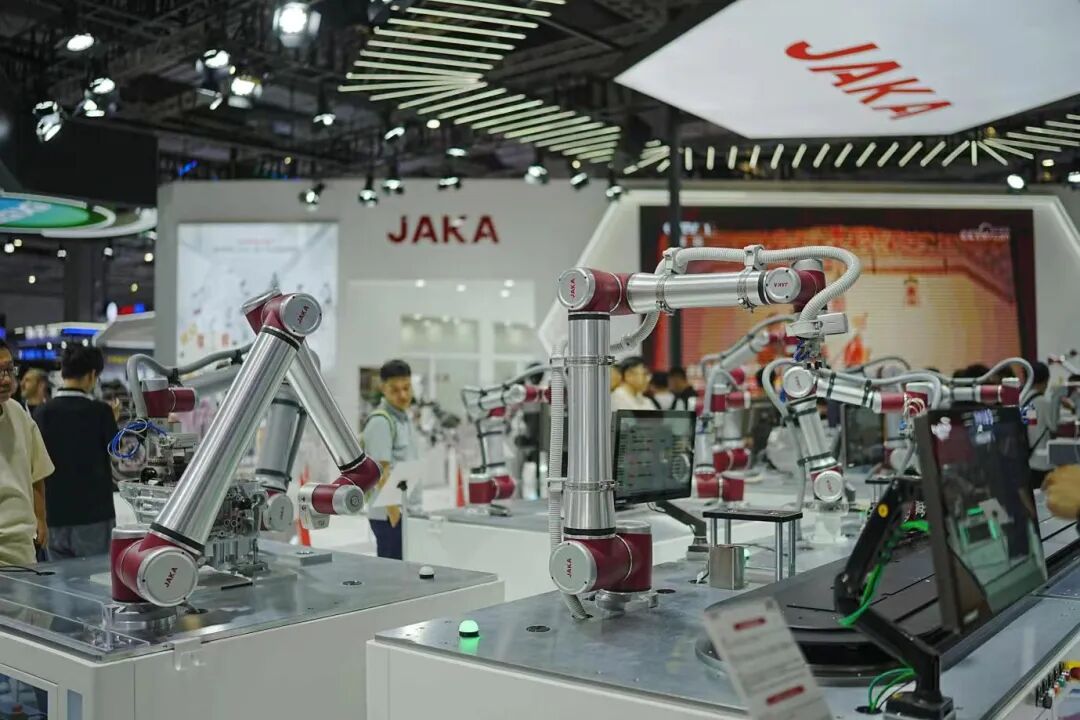
The evolution of the robotics industry is essentially a history of human-robot relationship iteration.
From replacing manual labor to collaborative work, and now to autonomous thinking and co-creation, the robotics industry is experiencing a revolution akin to "the shift from feature phones to smartphones."
In this revolution, every leap requires pioneering enterprises to break boundaries and define direction. In the collaborative robotics sector, JAKA is precisely such a trailblazer.
Before the Spring Festival, JAKA officially announced the launch of a new paradigm for human-robot co-creation in collaborative robotics. Through large model empowerment, it makes human-robot interaction in collaborative robots return to what's natural, truly achieving "conversation as a service."
As the collaborative robotics industry stands at the crossroads of human-robot relationship upgrades, JAKA has focused on the actual needs of industrial scenarios, targeting voice interaction to create four core functions: simplified parameter tuning, motion control, direct code output, and error troubleshooting—enabling collaborative robots to evolve from "tools that only execute commands" into "intelligent partners" that understand human language and think autonomously.
From lowering usage barriers to evolving into an embodied intelligence platform, JAKA has step by step transformed human-robot co-creation from concept into reality. With this core breakthrough, JAKA has, as a global first and industry pioneer, led collaborative robots into a new era of human-robot interaction—human-robot co-creation.
01. Initiating Collaboration: Global First to Lower Barriers, Making Human-Robot Collaboration Accessible
The development of collaborative robots cannot bypass two critical leaps: the first is making robots simple and easy to use, and the second is enabling collaborative robots to truly become intelligent. In both of these leaps, JAKA has left an irreplaceable mark.
In the early stages of human-robot collaboration development, traditional industrial programming technology laid a solid technical foundation for collaborative robot deployment and application. Through programming instructions by professional engineers, robots could complete standardized work tasks, playing an important automation role in industrial production.
At that time, collaborative robots, with their more flexible configuration characteristics compared to traditional industrial robots, gradually entered production scenarios across various industries. However, they were inevitably limited by operational challenges inherent to that stage of technological development—operational procedures required professional programming knowledge and debugging experience, with operators needing to precisely set parameters including robot motion points, gripper force, and work rhythm.
Even just switching simple work tasks required professional personnel to reprogram and debug. For small and medium-sized enterprises, this not only required dedicated technical staff, but also demanded considerable debugging time investment, preventing collaborative robots from achieving rapid large-scale adoption.
Precisely recognizing industry development needs and trends, JAKA leveraged years of technical accumulation to align with manufacturing's intelligent transformation demands, innovatively introducing graphical programming technology, simplifying and upgrading collaborative robot operation methods.
Users could program as easily as building blocks via web pages, tablets, or smartphones, dramatically lowering the barrier to robot usage, truly achieving "robots that anyone can freely use." This model later became an industry standard, driving the development of the entire collaborative robotics industry. With this pioneering innovation, JAKA established its position as an industry trailblazer.

Currently, JAKA's collaborative robots have been widely deployed across multiple industries globally, helping countless enterprises achieve intelligent transformation, making "human-robot collaboration" the norm in manufacturing. But JAKA has not stopped there. As manufacturing undergoes deep transformation toward flexibility and intelligence, market demands for human-robot relationships are no longer limited to "efficient collaboration," but increasingly pursue "value co-creation." JAKA has accordingly initiated a technical leap toward "human-robot co-creation."
02. Pioneering Co-Creation: Global First to Achieve Intelligent Upgrade, Creating a New Paradigm for Human-Robot Co-Creation in Collaborative Robotics
If graphical programming made human-robot collaboration accessible, then JAKA's globally pioneering intelligent upgrade of collaborative robots has truly created a new paradigm of "human-robot co-creation." The core of this upgrade is equipping collaborative robots with a "thinking brain."
JAKA, deeply cultivating the collaborative robotics track, has deeply integrated the JAKA Evo embodied intelligence platform (first unveiled at last year's CIIF) with collaborative robot platforms. While preserving the core genes of safety, flexibility, and ease of use in collaborative robots, it has achieved a qualitative transformation from "execution tools" to "intelligent agents."
In the past, collaborative robots only had the "body"—the robotic arm—without an autonomous decision-making "brain." All movements required human direction. Now, after connecting to the JAKA Evo large model, collaborative robots truly possess "perception-decision-operation" closed-loop capabilities.
They understand human language—no code writing needed. Workers can directly say "move the part on the left to the quality inspection station on the right," and it accurately understands the intent. They make their own decisions, automatically planning optimal motion paths, determining how to grip and move more efficiently—no human intervention needed. They can even solve problems themselves—when a malfunction occurs, just voice inquiries or input error codes, and it will provide problem localization and troubleshooting steps.
This is like upgrading from an old button phone to a smartphone—what used to require layer-by-layer operations can now be done with one sentence. The human-robot relationship has also shifted from "humans adapting to machines" to "machines adapting to humans." This is yet another disruptive innovation JAKA has brought to the industry.
The JAKA Evo embodied intelligence platform is not just a simple AI add-on, but an open capability foundation. All of JAKA's collaborative robots can connect to this platform, achieving AI-powered intelligent transformation across the full product line. Enterprises can also develop applications on the platform tailored to different scenarios including automotive electronics assembly, 3C sorting, and new energy welding, laying a solid foundation for the intelligent development of collaborative robots.
03. Value Reconstruction: The Deep Industry Transformation of Human-Robot Co-Creation
What does this mean for the industry?
Human-robot co-creation, at its essence, is co-creating value. The new paradigm of human-robot co-creation JAKA has initiated in the industry is not merely the company's own technological upgrade—it has brought tangible changes to the intelligent transformation of the entire manufacturing industry and achieved a qualitative leap in the industrial value of collaborative robots. This value is reflected in every aspect of manufacturing production, truly making intelligent manufacturing more inclusive, more efficient, and more imaginative.
First, lower barriers—anyone can use it. In the past, debugging robots and switching production lines required professional engineers to spend several days. Now, ordinary workers can accomplish it with one sentence, dramatically improving changeover efficiency. The demands for flexible production with small batches and multiple varieties can finally be implemented at low cost. For the vast majority of small and medium-sized enterprises, this is undoubtedly the best way to embrace intelligent transformation, making intelligent manufacturing no longer exclusive to large enterprises and allowing more manufacturing entities to participate in intelligent transformation.
Second, higher efficiency, lower costs. The capabilities of direct code output and automatic error correction reduce massive amounts of manual debugging time and equipment downtime. Robots can autonomously complete more tedious, repetitive work. This liberates professional engineers from mechanical programming and parameter tuning work, enabling them to invest their energy in high-value innovation work like process optimization and production line design. Ordinary workers can also easily participate in intelligent manufacturing, truly achieving each—human and machine—doing what they do best, collaboratively creating.
Finally, broader scenarios, greater value. Collaborative robots are no longer just "arms," but "partners," helping you solve more problems. The enhanced intelligence of collaborative robots means they are no longer limited to fixed industrial production scenarios—in the future, they can extend into more fields including life services and medical care. The industry's imaginative space is completely opened, enabling collaborative robots' industrial value to transcend singular production efficiency improvements, truly empowering more industries and scenarios, genuinely becoming high-value partners in human work and life.
This also aligns perfectly with JAKA's new positioning as a "globally leading general-purpose intelligent robotics company." From "bringing robots to every corner of the world" to "making robots high-value partners in human work and life." Since its founding in 2014, JAKA has consistently embodied the "enduring excellence" engineering spirit, continuously creating long-term value and surprises for users, building a robotics brand with warmth.
04. Redefining Collaborative Robots, Redefining JAKA
Every conversation is the heartbeat of technology; every iteration is the advancement of the industry.
From being the industry's first to introduce graphical programming, making human-robot collaboration accessible, to being the world's first to drive collaborative robots' evolution into embodied intelligence platforms, creating a new paradigm of human-robot co-creation—JAKA has always insisted on first being a pioneer, then a driving force.
With the first innovation, JAKA defined flexible collaborative robots. With the second innovation, JAKA defined intelligent collaborative robots. Every pioneering launch has driven overall industry progress, propelling technology from benchmark to standard. JAKA's innovation logic is clear: innovate not just for one company, but pave the way for an entire industry.
As the world's first collaborative robotics company to create a new paradigm of human-robot co-creation, JAKA represents not only itself, but also Shanghai Manufacturing and Chinese Intelligent Manufacturing's leading position in the global robotics race.
With the JAKA Evo embodied intelligence platform as its foundation, JAKA has opened the door to embodied intelligence for collaborative robots. Behind this door lie countless possibilities for manufacturing's intelligent transformation, as well as deeper integration between humans and machines.
And this evolution that began with "conversation" has only just begun.
Key Technological Breakthroughs
Previous Article
About the Author
Robotics Insider
Industry analyst with 15+ years of experience covering robotics and automation technologies.
View all articles


