
Currently, humanoid robots are rapidly evolving from "moving on stage" and "running on racetracks" toward "working in factories." However, getting them to truly "work well" and be "easy to use" in factories faces significant obstacles: deploying a single robot often requires 2-3 engineers spending several days on programming and debugging, while managing multiple robots becomes even more chaotic. The high labor and time deployment costs, coupled with inefficient cluster management, have deterred many factories.
Recently, Leju Robotics officially launched Taskor, China's first industrial embodied software platform. Built on two core components—the "Studio Toolchain" and the "Dispatch Platform"—the platform enables factory frontline personnel with no coding knowledge to orchestrate skills like building blocks, quickly deploying and efficiently managing an entire "workforce" of robot employees.
01. Studio Toolchain: No Code Required—Teaching Robots to Work is as Simple as Building Blocks
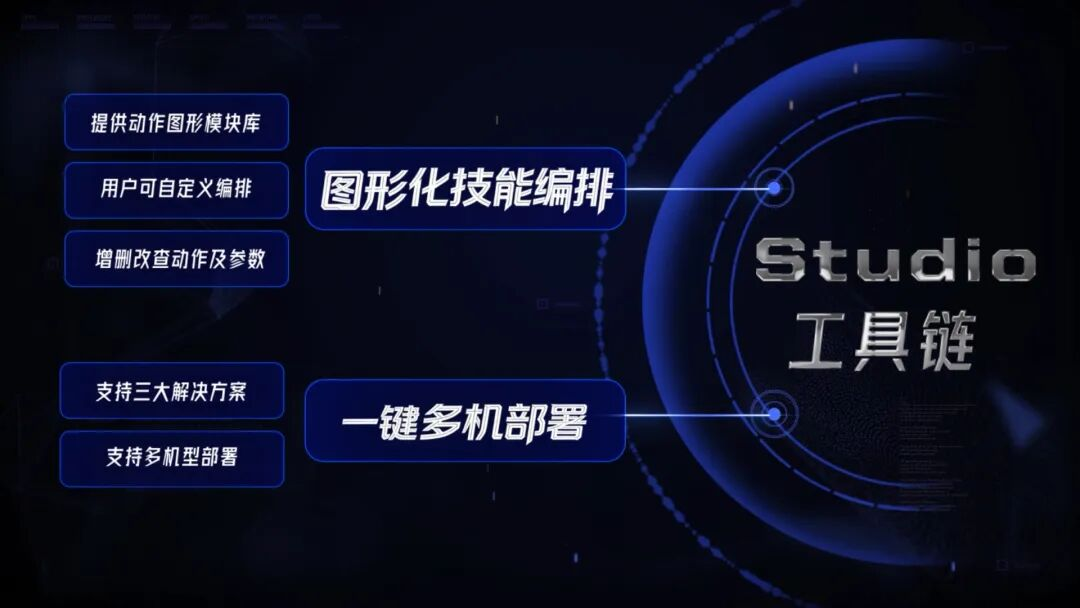
Traditional robot deployment relies on technicians writing code on-site—time-consuming, costly, and inflexible. Leju's Studio Toolchain, through innovations including graphical skill orchestration and one-click multi-robot deployment, has completely reconstructed the robot deployment model.
Skill Learning: "Zero-Code" Graphical Orchestration
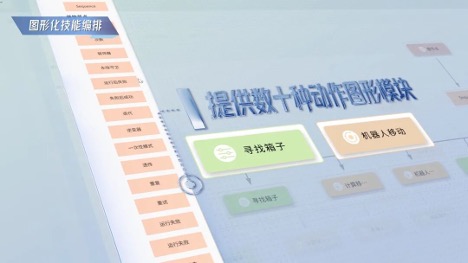
The Studio Toolchain's skill library comes pre-loaded with over 10 industrial-grade standardized action graphic modules, including "grasp," "move," and "place," along with basic task workflows (such as material box handling). Factory operators can drag and drop these graphic modules with a mouse according to actual factory scenarios, customizing a complete Standard Operating Procedure (SOP) to complete the "onboarding training" of a single robot.
Scenario Adaptation: Support for Adding, Deleting, Modifying, and Querying Robot Action Parameters
Modern factories face materials of varying sizes and vastly different workstation environments. Traditional debugging requires repeatedly modifying code, compiling, and testing. The Studio Toolchain supports direct CRUD (create, read, update, delete) operations on robot actions and parameters within the software interface. After pushing the adjusted SOP to the physical robot, synchronous feedback is provided, enabling rapid and precise on-site adaptation and flexibly handling various flexible, non-standard scenarios, truly bridging the "last mile" of industrial intelligence.
Batch Deployment: One Configuration, Multi-Robot Replication
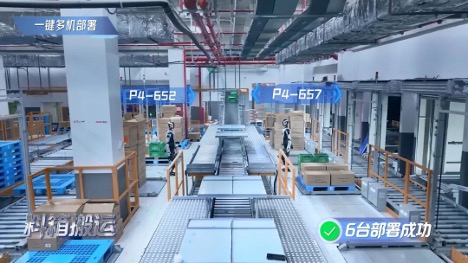
After debugging a standardized action SOP on a single robot, it can be pushed to multiple humanoid robots in the factory with one click, eliminating the need to repeat debugging for each unit individually. This solves the core replication challenge in scaled deployment, dramatically reducing factory deployment costs and truly achieving the leap from "single-unit application" to "mass deployment." Currently, the platform offers three major industrial solutions: material box handling, plastic box depalletizing, and SMT tray outbound operations, while supporting deployment across multiple robot configurations including humanoid and wheel-arm models.
02. Dispatch Platform: Global Visualization—The "Command Center" for Intelligent Task Assignment and Distribution
When multiple robots are running simultaneously in a workshop, how do you ensure they operate in an orderly manner without collisions? And how do they seamlessly integrate with existing production systems to accurately execute order tasks?
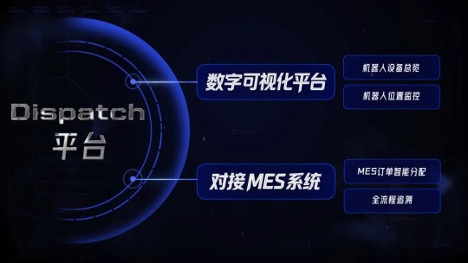
This is where the Dispatch Platform comes in—a "command center" built for robot clusters.
Global Perspective: Single-Screen Overview of Robot "Employee" Dynamics
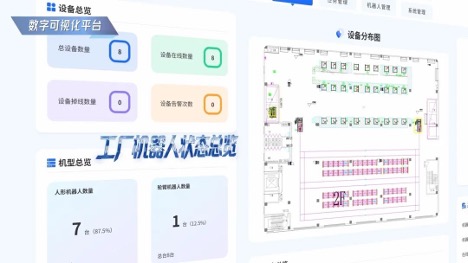
Managers can real-time monitor the status, location, and task progress of all robots through the platform's digital dashboard homepage. Which robot is idle, which is working, which has encountered an anomaly—it's all visible at a glance. This transparent global monitoring frees manpower from tedious on-site inspections, significantly improving management efficiency.
MES System Integration: Intelligent Factory Task Order Distribution
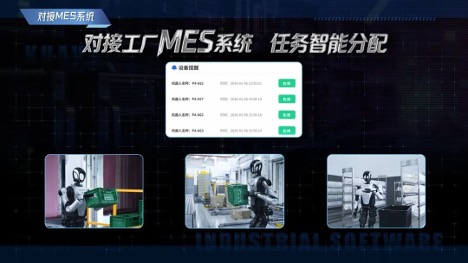
The Dispatch Platform seamlessly integrates with the factory's MES (Manufacturing Execution System). When the upstream system issues a "retrieve material tray" command, the platform can automatically receive it and intelligently assign it to the most suitable robot for execution, achieving a fully automated closed loop from order issuance to execution. This transforms robot clusters from information silos into intelligent workers deeply integrated into the production rhythm.
Data Traceability: Giving Every Operation a "Memory"
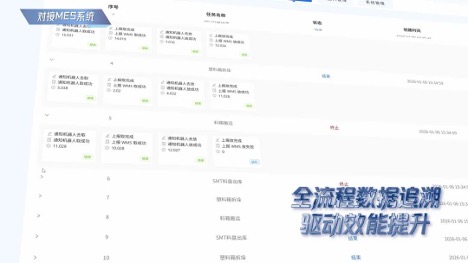
The platform also provides full-process data traceability, recording end-to-end data for every task from issuance to completion. This not only enables compliance management and issue traceability, but also provides factories with data-driven support for continuously optimizing workflows and improving overall operational efficiency.
03. Full Lifecycle Iteration: Building Industrial Productivity That "Grows for Life"
The vitality of technology lies in continuous evolution. This industrial software platform has created a "lifelong growth channel" for robots, enabling them to continuously upgrade in line with factory needs. In the future, without replacing hardware, robots can unlock new scenarios and new skills simply by upgrading features like multi-robot scheduling and OTA (over-the-air updates). This transforms them from "standard employees" completing fixed tasks into continuously upgraded "versatile experts" adapting to complex demands.
According to reports, Leju Robotics is partnering with leading enterprises including FAW Hongqi, JAC Motors, Haichen Corporation, and Goertek to continuously advance the industrial application of humanoid robots, having successively won China's automotive industry's first public tender for humanoid robots as well as the first public tender for deployed applications.
Its "Kuafu" robot has accumulated over 4,200 hours of deep testing in real industrial application scenarios including plastic box depalletizing, cardboard box depalletizing, and SMT tray outbound operations, with an average mean time between failures (MTBF) reaching 1,000 hours.
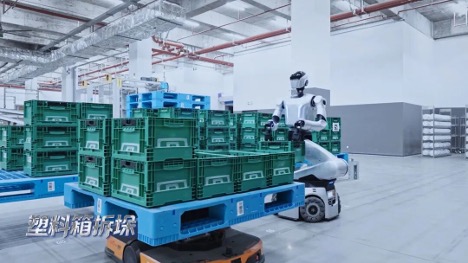
The launch of Leju Robotics' industrial embodied software platform Taskor not only hits the accelerator on transforming humanoid robots into "standardized industrial productivity tools" that are "practical and usable," but also marks Leju's pioneering step in taking the "critical leap" toward scaled, standardized industrial application of humanoid robots.
Key Technological Breakthroughs
Previous Article
About the Author
Robotics Insider
Industry analyst with 15+ years of experience covering robotics and automation technologies.
View all articles


